Square, where the others are round
Of the hundred or so structures built by the Republic of Genoa along the Corsican coast between 1530 and 1620, the vast majority are circular. This was not an aesthetic choice: a round shape removes blind spots for the watchmen and makes cannonballs glance off instead of taking their full force.
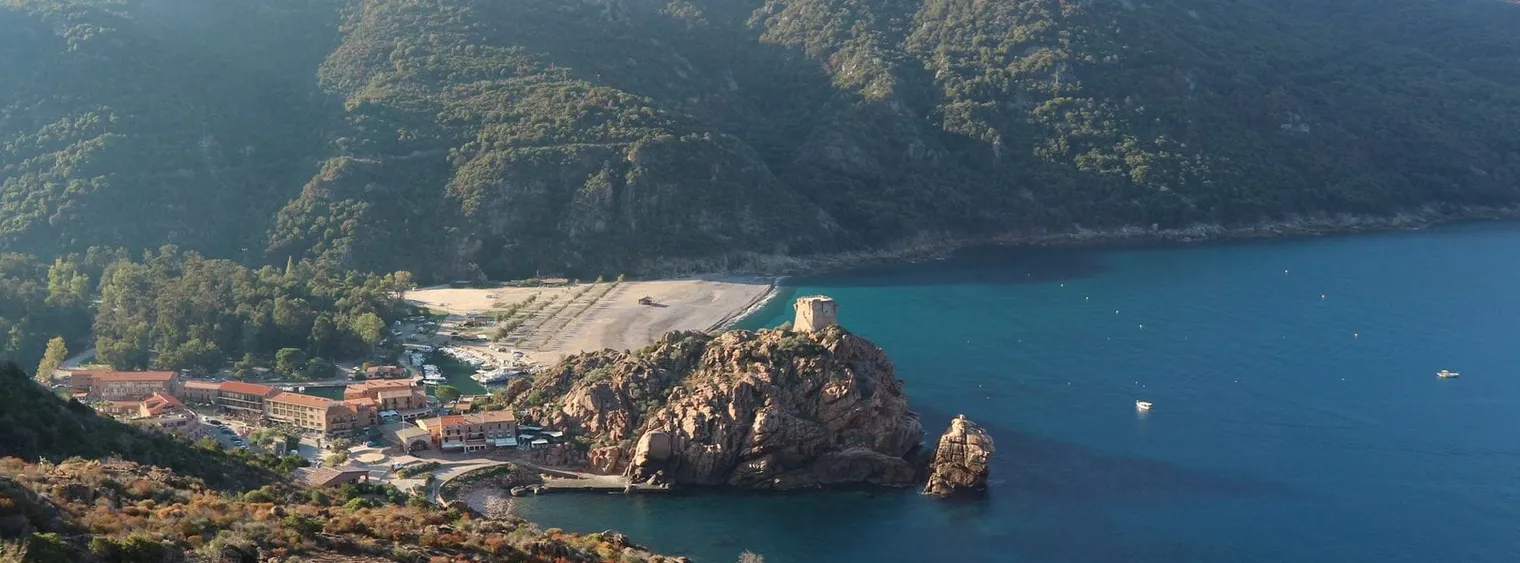
The tower at Porto is square.
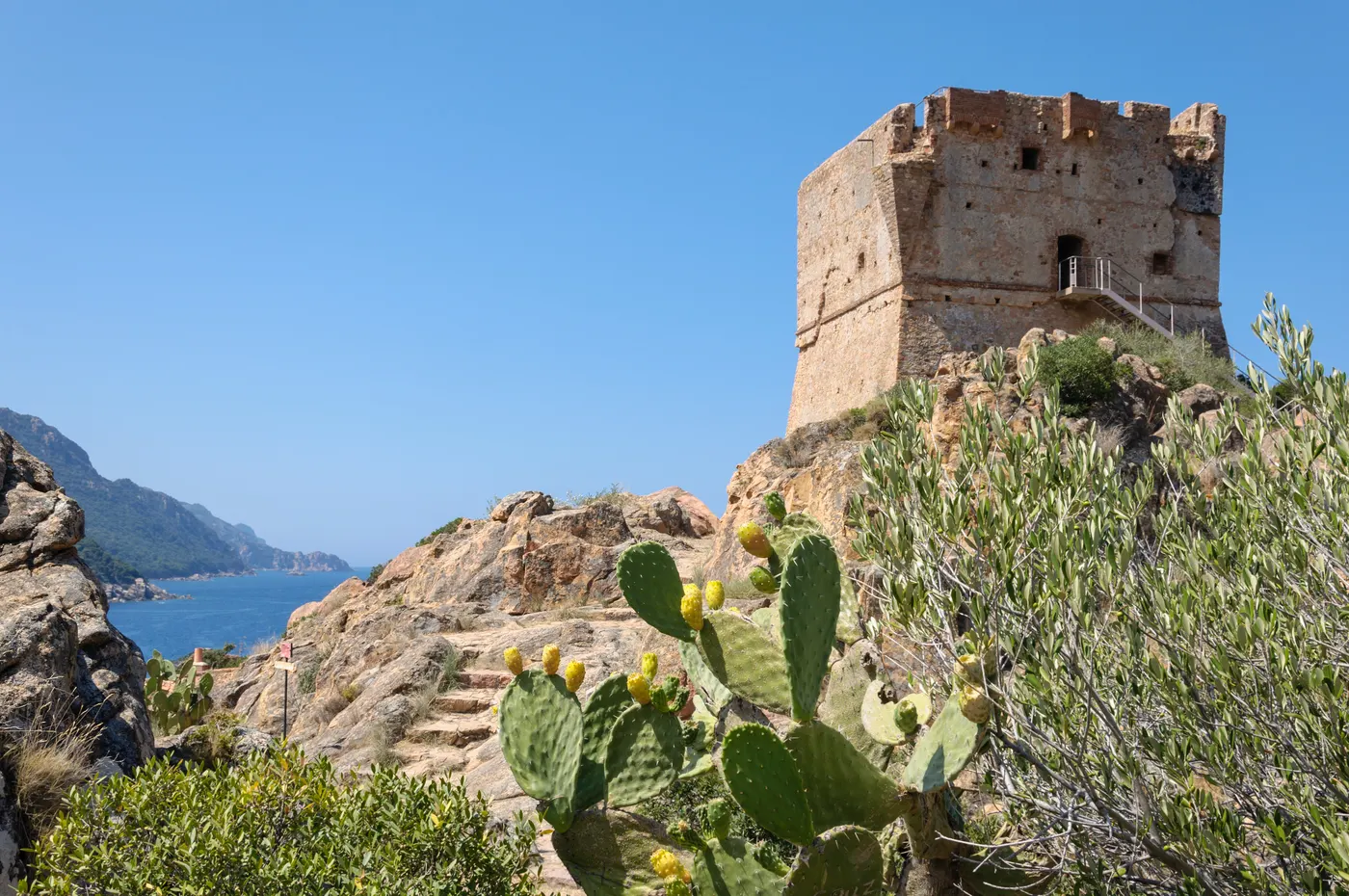
Photo Myrabella, CC BY-SA 3.0, resized and converted to WebP.
That singularity is not a local whim, it is a matter of chronology. The work of Antoine-Marie Graziani, a specialist in Corsican coastal defence in the early modern period, dates its construction to around 1551. It therefore belongs to the first generation, built while the right formula was still being sought, before the circular model became the Genoese standard.
This date also corrects an error that persists in a great many guidebooks: the tower at Porto is not Pisan. It is Genoese, and postdates the island's Pisan period by close to three centuries.
A state programme, not a local initiative
In the 16th century the western Mediterranean was a space of permanent raiding. Barbary corsairs did not only target ships: they targeted the coastal population. In 1560, a single operation launched from Algiers enslaved some six thousand Corsicans. The shores emptied and villages withdrew into the mountains — which is precisely why Ota sits ten kilometres above its own marina.
Genoa's response was what Graziani described as a genuine security industry, underpinned by a dedicated tax system, notably a levy on salt. As early as 1531, the decision was taken to build ninety further towers.
The network rested on one simple and formidably effective principle: every tower must be able to see another. The alarm travelled from one to the next, by smoke signals during the day and by fire or the sound of the culombu — the conch shell — at night. A suspicious sail sighted off Porto reached Ajaccio within hours.
Each tower was held by a small detachment of torregiani, two to six men often recruited locally, living on site in rough conditions. The building was self-sufficient: a rainwater cistern on the lower level, a vaulted living room above, a watch terrace at the top.
From the quay below, the valley's timber, oil, citrons and chestnuts were loaded aboard. The tower was therefore not simply watching a view: it controlled an economic outlet.
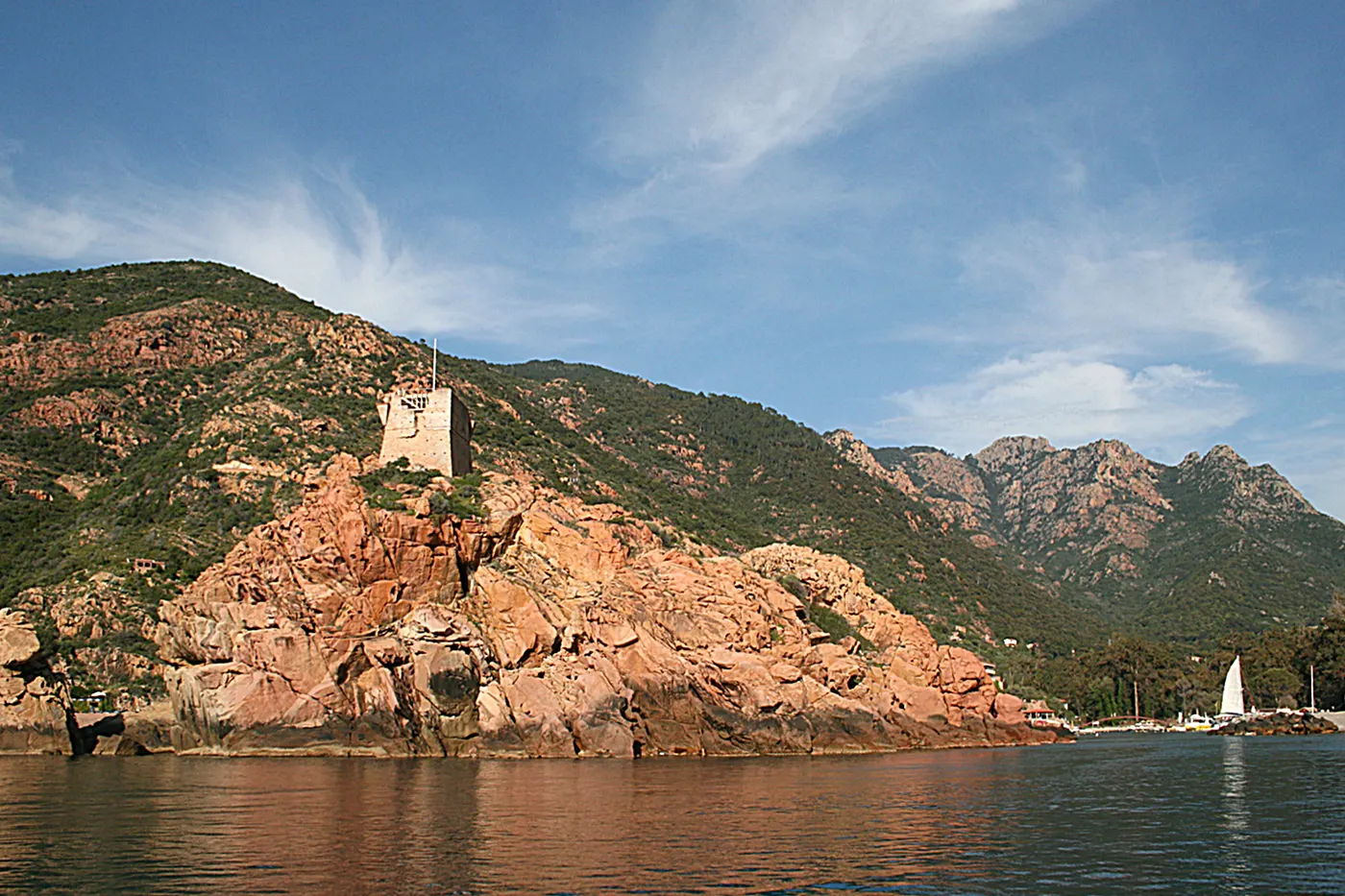
Photo Jean-Pol Grandmont, CC BY-SA 3.0, resized and converted to WebP.
The official description, and what saved it
The Mérimée database records a plain structure: rubble masonry bonded with fat lime mortar, a square section topped by an equally square mass, one door, arrow slits, a parapet wall enclosing the upper lookout platform, and masonry floor vaults.
It stands 45 metres above the sea, on a red granite outcrop at the mouth of the river. It rises 12 metres, and its walls are roughly two metres thick.
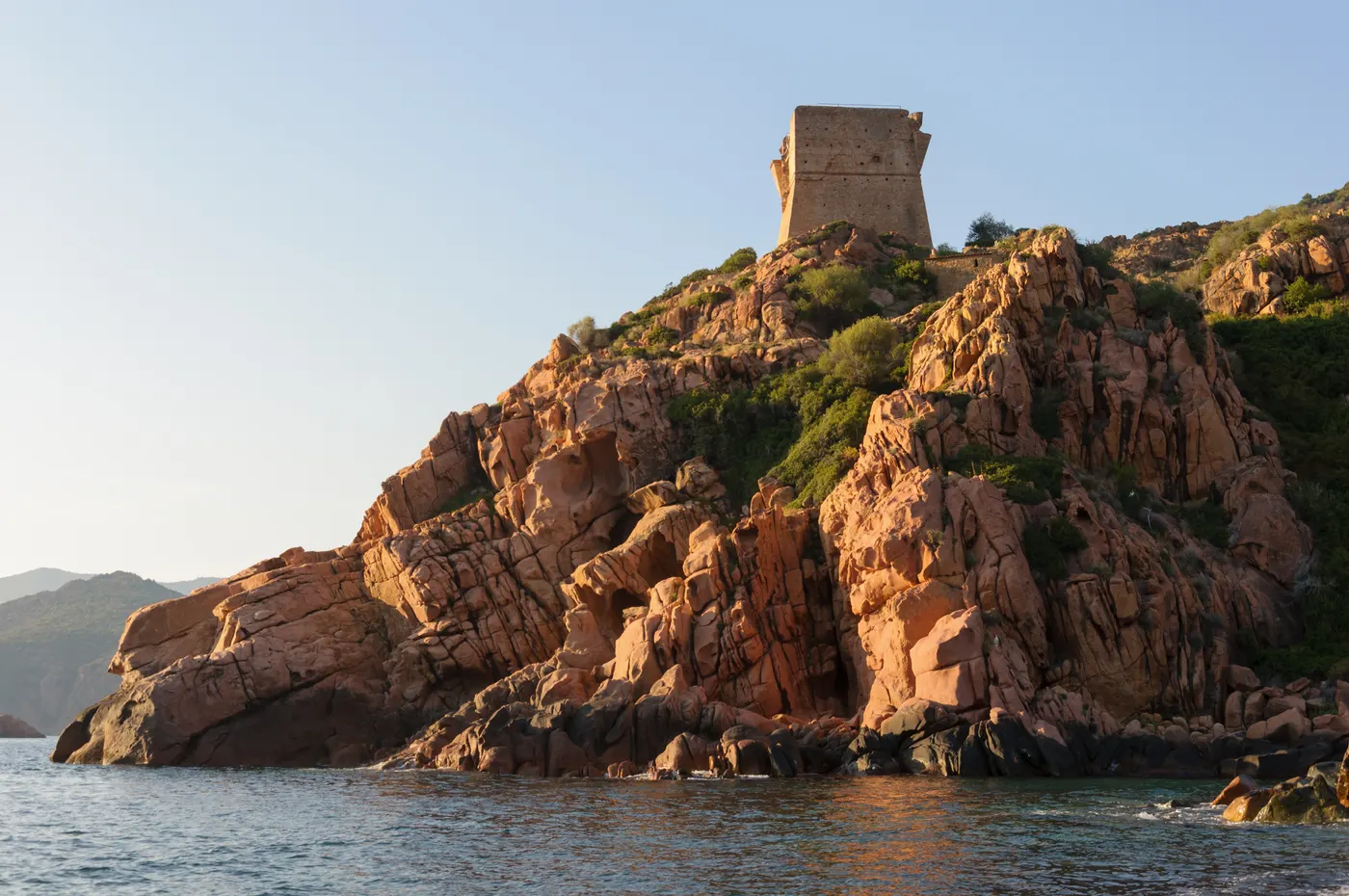
Photo Myrabella, CC BY-SA 3.0, resized and converted to WebP.
Remember that last figure. It explains everything that follows.
The explosion
By the end of the 18th century the tower was no longer a lookout post. A powder magazine had been installed inside.
It exploded.
The blast pulled the whole architecture out of true. The entire upper section split into separate blocks and the interior vaults collapsed. The tower should have disappeared within the decade. It owes its survival to the thickness of its walls alone.
Nearly two centuries of neglect followed: sea spray, winter storms, erosion. The photographs held by the blog Ota Porto Nostalgie, from 1910 to the 1940s, show a silhouette slowly hollowing out.
It was listed as a historic monument by decree of 22 June 1946.
1954 and 1993: two ways of saving a ruin
1954: a man from the village
By the early 1950s, four centuries after it was built, its condition had become critical. In the phrase used at the time, it was threatening to burst like a grenade.
The first restoration was carried out in 1954 by Armand Gelpi, foreman of the Société Française des Roches Cristallines — the company that quarried the valley's pink granite. This was not a state commission handed to a Paris practice: it was a local man, who knew the local stone, who stopped the bleeding.
It was also on this occasion that the access path cut into the rock, the one visitors use today, was opened. Before that, you climbed to the tower from the beach.
Armand Gelpi is the great-grandfather of a childhood friend, and it is his grandson who documents this history today on the blog Ota Porto Nostalgie.
1993: restoring without lying
Forty years later the Corse-du-Sud département acquired the tower and launched a second campaign to open it to the public.
The approach taken by the Bâtiments de France deserves note: no identical reconstruction was contemplated. The explosion is part of the building's history, and it was not to be erased.
The chosen solution was to tie the dislocated sections back to the sound ones using micropiles. The appearance of the ruin is preserved, its stability assured. The interior fittings are deliberately contemporary in character, so that no confusion with the historic fabric is possible.
The architects even kept the traces of the 1954 consolidation, taking the view that this work too belonged to the building's history. Inside, you can still see the stub of a beam poured by Armand Gelpi's team.
The works, costed at 1.7 million francs, were completed in 1993. They created a fifty-square-metre exhibition room and a viewing platform on the terrace. The tower is now owned by the département, with its management entrusted to the commune of Ota.
The heather museum
At the foot of the tower, slightly below the path, a small stone house holds a museum that many visitors come across by chance — admission is included in the tower ticket.
It is devoted to a shrub: tree heath, a scopa in Corsican, everywhere in the maquis of the gulf.
This is not a trivial subject. It is the root of this plant — more precisely the burl that forms between the stump and the roots — that yields one of the hardest and most heat-resistant woods known. From the 1850s, when the turners of Saint-Claude in the Jura discovered its qualities for making pipe bowls, demand exploded. Areas of Mediterranean maquis became extraction zones, and Corsica became one of the suppliers of blocks to that industry.
The museum traces this history, along with the gulf's forestry past and the 19th-century timber trade. It is a reminder that this small harbour, today turned towards sea excursions, was first a commercial port living off what the valley produced.
Visiting the tower
From the marina, access takes about fifteen minutes on foot by the granite path opened in 1954, with no particular difficulty. It is, however, not accessible to visitors with reduced mobility.
Inside there is a permanent exhibition on the torregiana, the Genoese defence system of the Corsican coast. From the terrace you take in what the watchmen were watching: the Scandola reserve to the north-west, the Calanques de Piana to the south-west. Only one other tower remains visible from here, that of Capo Rosso, some ten kilometres away — the last still-legible link in a chain that once ringed the island.
Allow thirty to forty-five minutes for the tower and the museum, more if you linger on the terrace. The late-afternoon light, just before sunset, is by far the finest.
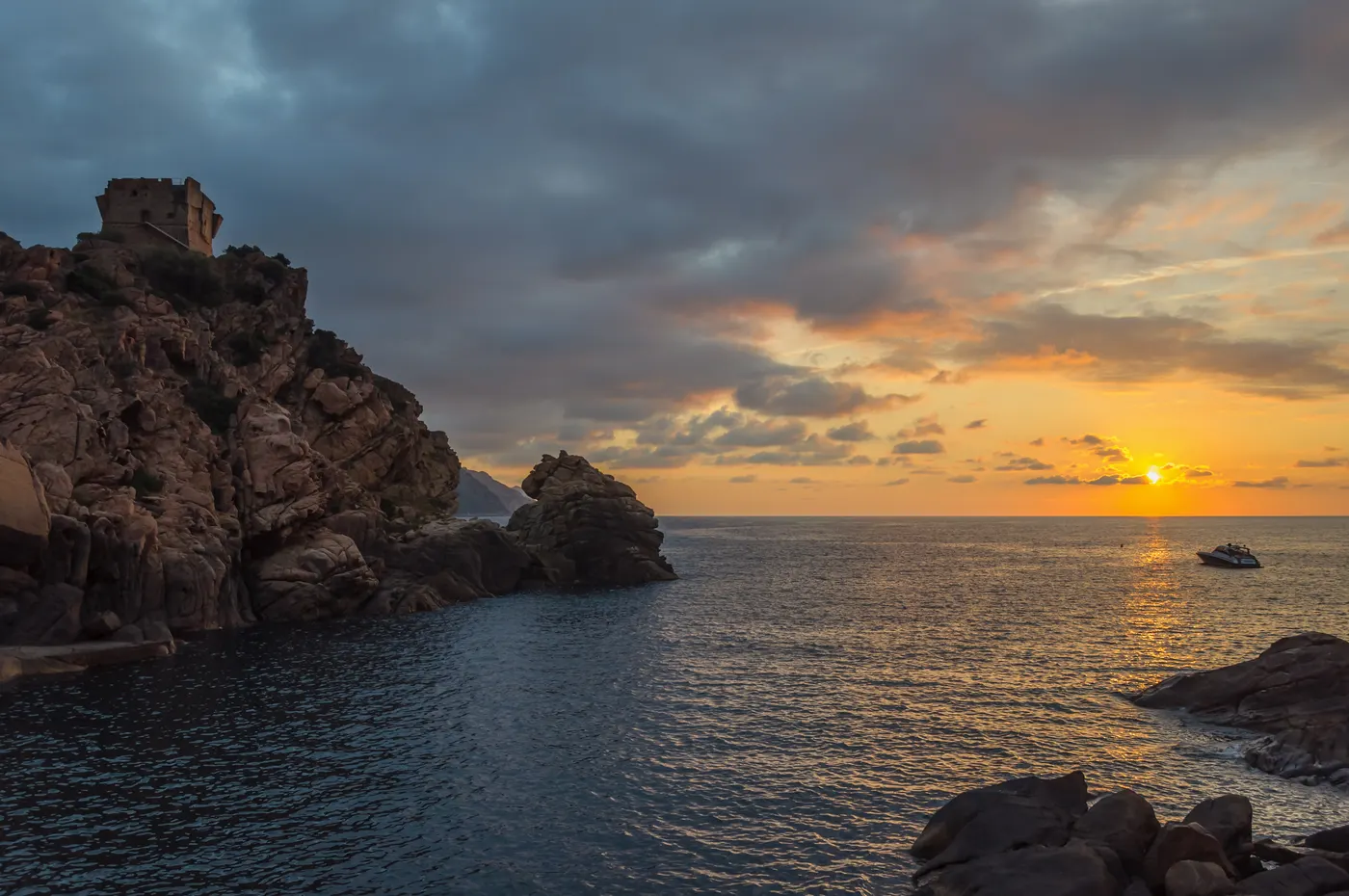
Photo Myrabella, CC BY-SA 3.0, resized and converted to WebP.
Seasonal opening, paid admission covering both the tower and the museum. Times and prices from the Porto tourist office, housed in the former warehouse built at the same time as the tower to store the harbour's goods.
Two extra stories
The tower appeared on German television. In 1966 ZDF filmed Die Schatzinsel (Treasure Island), a mini-series after Stevenson directed by Wolfgang Liebeneiner, between Brittany, Corsica and Lake Garda. The Gulf of Porto features in it — something a few German-speaking guests still recognise.
And Bear Grylls passed through. The British adventurer came to Corsica in 2016 to film an episode of Running Wild (NBC) with the American footballer Marshawn Lynch. We were there.
Sources
Academic references
- GRAZIANI, Antoine-Marie, Les tours du littoral de la Corse. Sentinelles de la mer, XVIe-XVIIIe siècles, Ajaccio, Éditions Alain Piazzola, 2019.
- GRAZIANI, Antoine-Marie, “Les ouvrages de défense en Corse contre les Turcs (1530-1650)”, in M. VERGÉ-FRANCESCHI and A.-M. GRAZIANI (eds.), La guerre de course en Méditerranée (1515-1830), Paris-Ajaccio, Presses de l'Université Paris-Sorbonne / Éditions Alain Piazzola, 2000, pp. 73-144 (tower of Porto: p. 110). Proceedings of the Bonifacio university conference, 1999.
- GRAZIANI, Antoine-Marie, Les Tours littorales, Ajaccio, Éditions Alain Piazzola, 1992.
- GRAZIANI, Antoine-Marie, “‘Domaines coloniaux’, industrie sécuritaire et système fiscal en Corse à la fin du XVIe siècle”, Mélanges de l'École française de Rome, no. 103, 1991, pp. 461-520.
- ISTRIA, Daniel and HARNÉQUAUX, Mathieu, “La protection du littoral: un enjeu majeur aux XVIe et XVIIe siècles”, in Sevi-Sorru-Cruzzini-Cinarca, CRDP de Corse, p. 20.
Documentary sources
- Base Mérimée, record no. PA00099100, open heritage platform, French Ministry of Culture.
- Ota Porto Nostalgie, “Restauration de la Tour de Porto”, otaportonostalgie.fr — photographic archives and local testimony, including extracts from an article by François Fazi published in La Corse, June 1993.
The tower is a fifteen-minute walk away
Hôtel Le Vaïta sits on the marina of Porto, at the foot of the path up to the tower. 26 air-conditioned rooms with a view of Capo d'Orto, and a reception desk that knows the day's opening hours.